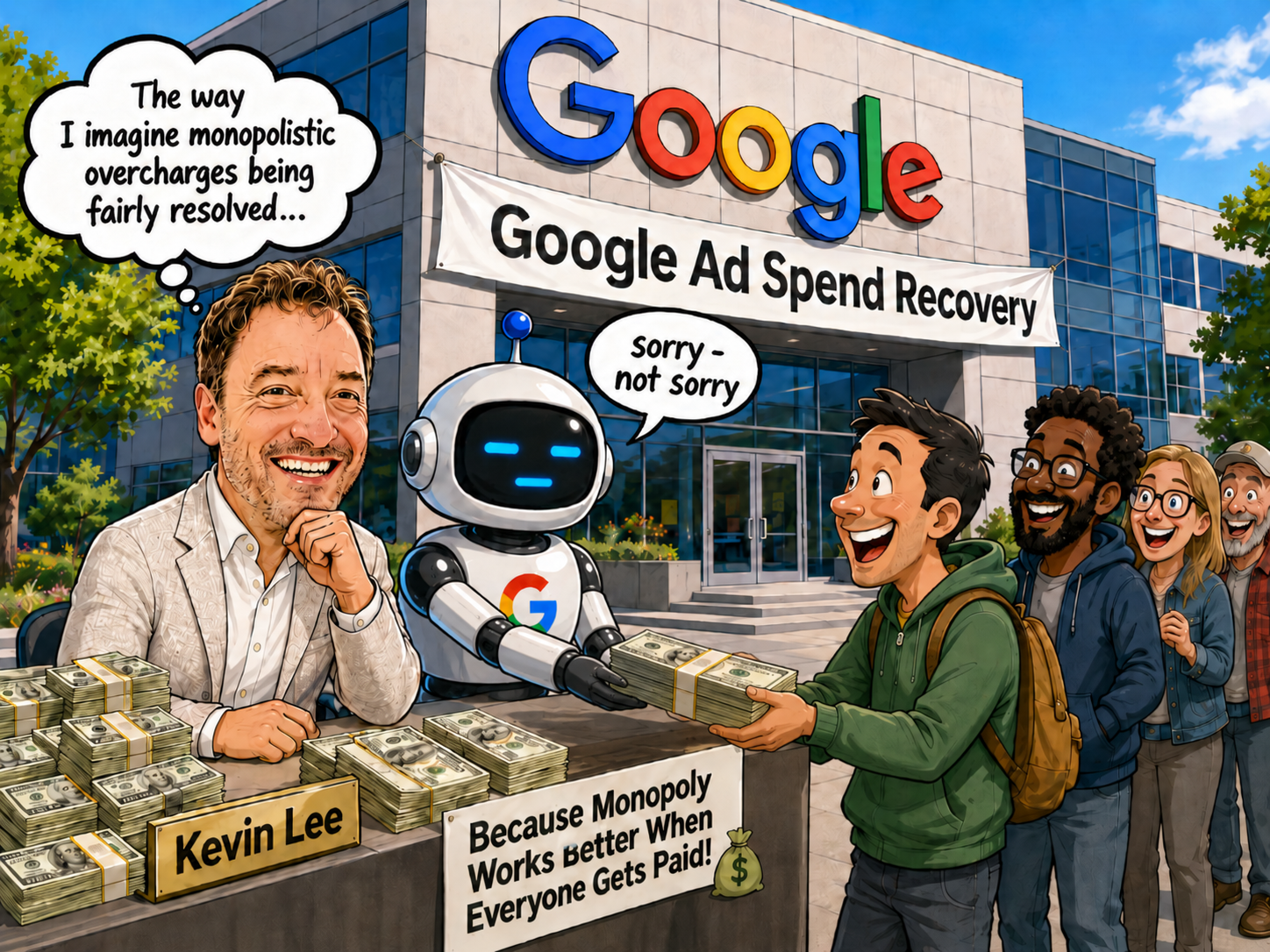
Large Google Advertisers Demand Justice via Mass Arbitration for Ad Spend Recovery

Posted by:

|

On:

|


The Quiet Reckoning: Large Advertisers Pursue Mass Arbitration Against Google for Ad Spend Recovery

Thousands of companies that spent millions or billions of dollars on Google advertising over the last ten-years are now quietly mobilizing to recover what they believe were unlawful overcharges, and the scale of potential damages is staggering. Led by Chicago-based law firm Keller Postman, a growing mass arbitration effort is targeting Google for monopolistic pricing in both search and display advertising, with total potential claims estimated to exceed $218 billion based on current data )mid-April 2026). For larger advertisers, those spending $5 million or more annually, this is not just a legal formality. It is a rare opportunity to claw back years of inflated ad costs that industry observers, agree with me were both systematic and preventable .latimes Running an agency (Didit) and in my role with the eMarketing Association I”ve concierged in over $1 Billion in claims myself.


The Legal Foundation

The mass arbitration cases do not start from scratch. They rest squarely on the shoulders of two landmark federal antitrust rulings against Google. In 2024, two separate U.S. federal judges adjudicated that Google had illegally monopolized the online search advertising market and the sell-side ad technology market, finding the company had abused its dominant position to artificially inflate prices paid by advertisers. Attorney Ashley Keller, whose firm Keller Postman has previously won mass arbitration cases against DoorDash, Postmates, and Intuit, stated plainly: “Two federal judges have already adjudicated Google to be a monopolist. It seems sensible to seek redress.”adexchanger+2

Because Google’s advertiser contracts contain mandatory arbitration clauses that block class-action lawsuits, Keller Postman pursued the mass arbitration model instead. Under this structure, 25 or more similar claims are pooled together, dramatically shifting leverage toward claimants and increasing the likelihood of settlement. The firm has already signed up a “significant number” of advertisers and expects that similar mass arbitrations, which typically resolve in 12 to 24 months, will yield meaningful recoveries.searchengineland+1. I


The Core Claim: Monopoly Profits Were Passed to Advertisers as Inflated Costs

At the heart of the arbitration claims is a straightforward economic argument: monopolists charge more than the free market would allow, and Google’s monopoly power meant advertisers had no real choice but to absorb those inflated rates. Keller Postman’s commissioned economist estimates that advertisers overpaid somewhere in the range of 10 to 25% above what they would have paid in a genuinely competitive marketplace.adsrefund+2

Federal courts found that Google set artificial reserve or floor prices in its ad auctions, essentially minimum bids that ensured winning advertisers almost always paid above-market rates. Even when all bidders submitted bids below the floor price, the winning bidder was still required to pay the floor price, a mechanism that systematically extracted surplus from advertisers on every auction cycle. Combined with Google’s integration of its ad-serving, exchange, and bidding platforms into a single closed system, the result was a market where no genuine competition on price was possible.classaction+2


“Ad Inflation” Through Subsidized Credits

One of the more nuanced but significant allegations centers on what claimants describe as “ad inflation” driven by Google’s subsidized ad credits. Google has historically offered advertising credits to new and returning customers, free spend incentives designed to encourage adoption and higher budgets. Claimants allege these credits distorted the auction ecosystem by artificially inflating perceived demand, driving up click costs across all participants in the auction, including those who received no credits. Advertisers who were never offered credits effectively subsidized those who were, paying more per click because of an artificially elevated floor in competitive auctions.reddit

This mechanism is particularly relevant for large advertisers spending in excess of $5 million annually, who operate in the most competitive keyword markets where floor pricing and auction manipulation would have the greatest compounding effect over time.adexchanger+1


What Discovery May Reveal Beyond the Antitrust Record

The antitrust rulings, while foundational to the arbitration claims, only scratch the surface of what claimants allege actually occurred. One reason I’m so optimistic and have personally facilitated the submission over $1 billion in Google ad spend for recovery through Keller Postman is that I’ve seen first hand where client accounts have manifested behavior that was difficult to explain through other than artificial manipulation of quality score, match types, and targeting options. I have written extensively about additional manipulations that may be exposed through arbitration-specific discovery that goes above and beyond what was uncovered in the government antitrust proceedings.emarketingassociation

Chief among these are allegations of Quality Score manipulation. Quality Score is Google’s proprietary 1–10 rating assigned to keywords that, along with bid amount, determines Ad Rank and the cost per click an advertiser ultimately pays. Advertisers have long accepted Quality Scores as objective assessments of ad relevance, expected click-through rate, and landing page experience. But if discovery reveals that Google manipulated Quality Scores in unfounded ways, artificially suppressing scores to drive up CPCs, or inconsistently applying scoring metrics based on advertiser size or campaign type, it would constitute a separate and deeply troubling layer of advertiser harm beyond simple monopoly pricing.youtube

Similarly, allegations regarding match type manipulation deserve close scrutiny. Google has progressively broadened the definition of “broad match” and “exact match” keyword matching over the years, often routing advertiser budgets to queries that advertisers did not intend to bid on. When match types are manipulated or quietly redefined without advertiser knowledge, spend is directed toward lower-quality impressions and clicks, increasing costs while degrading ROI. Discovery may reveal whether these changes were algorithmically designed to maximize Google revenue rather than advertiser outcomes.adexchanger

Beyond Quality Score and match type, the arbitration discovery process may expose ad rank manipulation more broadly, including whether Google’s auction algorithms were calibrated to favor certain outcomes that served Google’s financial interests over advertiser performance. The antitrust cases documented Google’s abuse of its integrated position across the ad stack; arbitration-level discovery has the potential to surface the specific engineering decisions that translated that structural power into advertiser overcharges on a keyword-by-keyword and impression-by-impression basis.


Invalid Traffic and the Filtering Gap

Another critical area flagged by me and other industry observers involves invalid traffic (IVT), clicks, impressions, and engagements that do not come from real users with genuine commercial intent. Google defines IVT as any engagement that could “artificially inflate an advertiser’s costs” and maintains policies requiring publishers to prevent their ads from generating such activity. Yet third-party auditors and advertisers have long questioned whether Google’s IVT filtering, applied before billing, meets best-practice standards or whether it is calibrated in a way that systematically underestimates invalid activity.adexchanger

The concern is not merely that bad actors generate fraudulent clicks. It is that Google’s own standards for what constitutes “invalid” may be looser than what leading independent verification firms have measured in the same inventory. If discovery reveals that Google’s filtering thresholds were set at levels that knowingly allowed a higher volume of invalid impressions and clicks to be billed to advertisers than a best-practices approach would have permitted, that represents an additional, quantifiable source of advertiser harm layered on top of the core monopoly pricing claims.adexchanger

Google has recently touted a 40% reduction in invalid traffic through new AI-powered detection methods, an improvement that, while welcome, implicitly acknowledges that prior systems left significant invalid activity undetected and billed to advertisers.searchengineland


Large Advertisers and the “Concierge” Process

For advertisers spending $5 million or more on Google annually, the stakes of the arbitration are material. I have noticed an unusual dynamic: despite privately acknowledging that Google is a monopoly and that claims are valid, a striking number of CMOs and brand executives refuse to discuss the arbitration publicly. The reasons are straightforward: Google remains the dominant search and display advertising platform for most large businesses, and advertiser teams fear that openly challenging Google could lead to informal retaliation, degraded account support, reduced access to beta products, or subtler algorithmic disadvantages.emarketingassociation

To address this new form of monopolistic overchargte recovery, Keller Postman has developed what industry insiders describe as a “concierge” process for larger advertisers. This approach allows high-spend claimants to participate in the mass arbitration with a significantly higher degree of discretion and confidentiality than would be possible in public litigation. Claims are processed with insulation from public filings that would directly identify the advertiser, enabling brands spending hundreds of millions of dollars on Google media to pursue recovery without making their legal conflict with Google front-page news. Ashley Keller has confirmed that his firm represents multiple major businesses that have spent hundreds of millions of dollars on Google advertising.adexchanger+1


The Scale of the Opportunity, and the Silence Around It

The my analysis published on eMarketing Association’s site, raises a pointed question: why are so many of the largest, most sophisticated marketing organizations in the world staying silent about a legal action that could return tens or hundreds of millions of dollars to their bottom line? The answer lies in the power asymmetry that Google’s monopoly itself created. As I noted: “If the evidence clearly shows monopoly profits in search and display, the only fair thing is for Google to return that unfair monopoly profit to advertisers. If it takes a mass arbitration to result in a fair outcome, I’m all for it.”emarketingassociation

The full analysis of the claims is available on the eMarketing Association website, where I have documented both the legal framework and the broader industry dynamics that have kept so many large advertisers on the sidelines despite compelling evidence of overcharges. With potential total damages exceeding $218 billion, and with arbitration timelines running 12 to 24 months, the window for large advertisers to join the recovery effort, and do so quietly through the concierge process, remains open, but not indefinitely.emarketingassociation+3

Posted by

in

Leave a Reply

Your email address will not be published. Required fields are marked *