
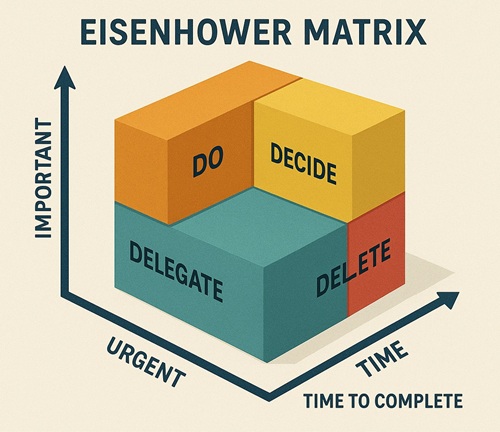
Steven Covey popularized the “Eisenhower Decision Matrix” to help people plan out their day and their projects. The EDM was derived from a famous remark made by General Eisenhower: “What is important is seldom urgent and what is urgent is seldom important.”
But the Eisenhower Decision Matrix is a great tool to use for prioritizing resources in any marketing campaign you’re running, or even overall marketing tasks. It can keep your team on track and avoid the chaos that can appear when everyone is running around “putting out fires.”
The Eisenhower Decision Matrix has four quadrants mapping the urgency of tasks against their overall importance to the business:
Urgent tasks/Important tasks Non-urgent tasks/Important tasks
Urgent tasks/Unimportant tasks Non-urgent tasks/Unimportant tasks
I add time as the third Z dimension.
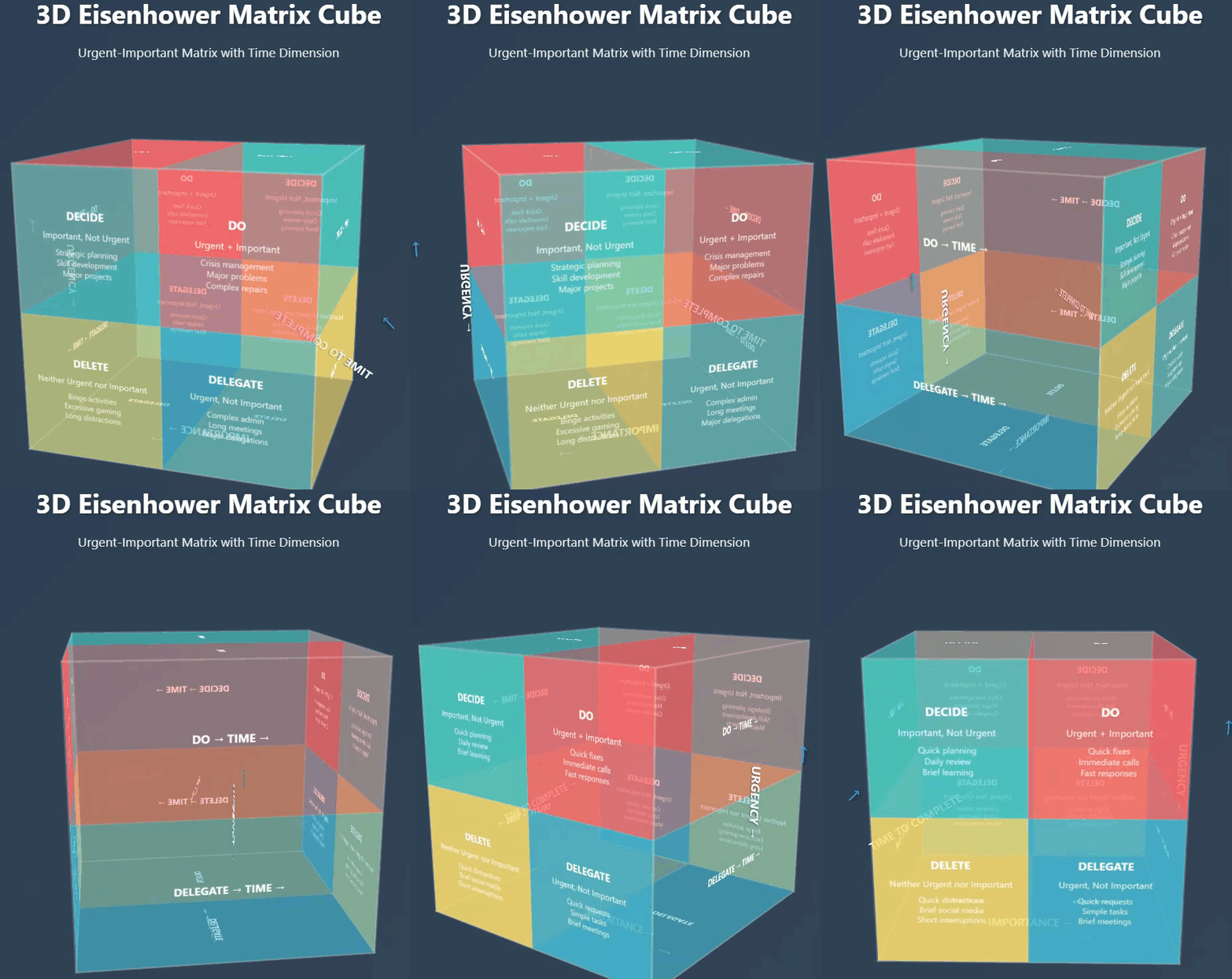
I’ve even hacked the Eisenhower Decision Matrix by adding a third dimension within each quadrant, in particular the first quadrant. The additional dimension I like to use when deciding prioritization within quadrants is Difficulty/Ease or fast vs long projects. I’ll provide more on why that can be a helpful factor to consider later on.
First let’s talk about each quadrant in detail:
Quadrant 1: Urgent tasks/Important tasks
Unfortunately Quadrant 1 is where many of us marketers spend too much of our time. An ad is broken, a site is down, a mail piece is misprinted, or a client is unhappy. The result is an “all hands-on-deck “full court press” effort to clear the emergency and get back to some semblance of normality.
The costs of having yourself — or your staff – spending a lot of time in Quadrant 1 is burnout, turnover, and a work environment where everything is always at DEFCON 1. In project management, being in Quadrant 1 is known as “crashing the time” and it’s a state to be avoided at all costs because mistakes are so often made while in it.
You and your team will inevitably have to spend a considerable amount of your time in Quadrant 1, because business life is unpredictable and there will always be “fires” that have to be put out. But the trick is to use the system to focus on the marketing tasks within this quadrant of important and urgent that have the most material impact on your marketing KPIs. Hit home runs on your KPIs and your chances of a raise, bonus or promotion just got better.
Quadrant 2. Non-urgent tasks/Important tasks
Quadrant 2 is the “sweet spot” where management gurus say we should strive to spend more of our time and mental energy, particularly if we have strategic or management responsibilities. In this quadrant, there’s time for deliberative thought, evaluation, and creativity. Deadlines are understood and resources are allocated in time to meet them. Surprises are few and goals are long-term and strategic. You can’t completely eliminate surprises and crisis from happening, but if you do a great job of managing things in Quadrant 2, you’ll spend less time in Quadrant 1. Procrastinate within quadrant 2 and you have a crisis that moves into quadrant 1.
In Quadrant 2, as a manager you have the freedom to delegate, to let your team work its magic, and to think long and hard about the strategies and tactics most likely to move the needle for your business.
Both digital project management platforms and a whiteboard with post-it notes can work to organize your initiatives and tasks into quadrants and perhaps use color coding to indicate difficulty of completing the tasks and initiatives.
Quadrant 3. Urgent tasks/Unimportant tasks
Why spend any time in Quadrant 3, where urgency — masking as importance — bogs you down in tasks that aren’t really that important? Well, there’s no good reason other than the fact that we humans are easily distracted, and today — in the era of social media and multitasking — our attention is constantly being divided.
Let’s be frank here too: corporate culture often rewards an appearance of activity irrespective of whether this activity is crucial or tangential to the business’ strategic goals. The result is a conflation of “busy-ness” and “business.”
Reducing the “urgent but unimportant” task load isn’t easy, because it’s often a product of culture, culture isn’t easy to reform, and there’s often no general agreement on what “business critical” goals are in any organization. Clarity on this issue usually flows from the top (but unfortunately and ironically, many C-level executives spend so much time in Quadrant 1 that they never get to this important goal).
Quadrant 4. Non-urgent tasks/Unimportant tasks
In a perfect world, Quadrant 4 wouldn’t even exist or it would be empty (have nothing in it). Ideally, neither you or any of your team should be doing any non-urgent, unimportant initiatives or tasks. In the age of Facebook, Twitter, Buzzfeed, and the Huffington Post, tolerating some level of Quadrant 4 activities is probably inevitable, but you should still strive to move the bulk of activities to Quadrant 2.
By hacking the Eisenhower Decision Matrix by adding difficulty one can accomplish the initiatives and tasks that move the needle more quickly. Color coding or tagging the tasks is a great way to do that. Go rock your quadrants.